
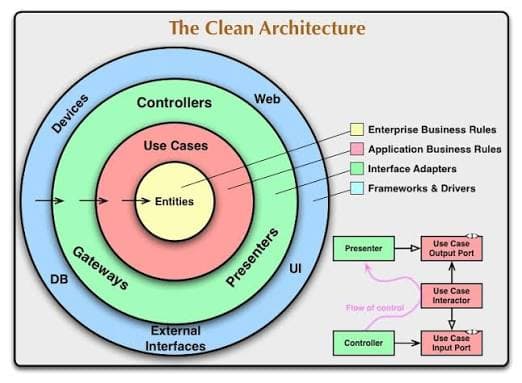
Enterprise software is not a one-time build — it's a long-term investment. The architecture decisions you make today determine whether your system can evolve with your business or becomes a maintenance nightmare.
The Problem with Quick Fixes
Many teams prioritize speed over structure, leading to tightly coupled code, business logic scattered across controllers, and databases that drive the entire application design. This works for MVPs but fails at enterprise scale.
Clean Architecture Benefits
Clean Architecture separates concerns into distinct layers:
- Domain Layer — Business entities and rules, independent of any framework
- Application Layer — Use cases and business logic orchestration
- Infrastructure Layer — Database access, external services, file systems
- Presentation Layer — API controllers, UI components
This separation means you can swap databases, change UI frameworks, or modify business rules without rewriting the entire system.
SOLID in Practice
At Amlogics, every project follows SOLID principles:
- Single Responsibility — Each class has one reason to change
- Open/Closed — Open for extension, closed for modification
- Liskov Substitution — Subtypes must be substitutable for base types
- Interface Segregation — Clients shouldn't depend on unused interfaces
- Dependency Inversion — Depend on abstractions, not concretions
Real-World Impact
Our Next Generation Academic ERP system was built with Clean Architecture from day one. When we needed to add a new payment gateway, we only modified the Infrastructure layer — zero changes to business logic or the UI.
Learn more about our custom software development services or contact us to discuss your architecture needs.
Testing Becomes Practical
When business logic lives in the Application layer, you can unit test use cases without spinning up databases or HTTP servers. Infrastructure implementations are swapped for mocks in tests. This dramatically reduces regression risk as teams grow and features accumulate.
Onboarding New Developers
Clean Architecture gives new team members a mental map on day one. They know where entities live, where API endpoints sit, and where database code belongs. Code reviews become faster because violations of layer boundaries are easy to spot.
Migration and Modernization
Legacy systems often fail because everything is tangled together. Clean Architecture lets you strangle a monolith incrementally — replace the data layer, then external integrations, then presentation — without halting feature delivery. This is how enterprise teams modernize without multi-year rewrite projects.
Common Mistakes to Avoid
- Putting business rules in controllers or UI components
- Letting database schema dictate domain models
- Skipping interfaces between Application and Infrastructure
- Treating architecture as documentation only — enforce it in code reviews
Conclusion
Invest in architecture early. The upfront cost pays dividends in maintainability, testability, and team velocity for years to come. If you are planning a new enterprise system or refactoring a legacy platform, reach out to Amlogics for an architecture assessment.